A beauty brand is only real once it survives formulation, packaging, labels and production. Here is the manufacturer’s route from identity to launch.
01 · DefinitionWhat Beauty Branding Is and Why It Has to Include Manufacturing
Beauty Branding is how a cosmetics company decides what it means to customers. It includes each contact the consumer has with the brand: logo, colors, fonts, brand history, packaging, and the Experience of using the product after buying. Search queries follow the same parameters. Owners of brands usually inquire about how to establish a new beauty brand, and what makes a brand appear upscale. Only rarely do people inquire only about Design. Most often they wish to learn about the whole process of developing a brand and marketing that brand.
Why does a Design-only point-of-view fail?
Many of the articles currently ranked for Beauty Branding were written by either a Design firm or a writing agency. Therefore, their focus stops with mood boards, logo ideas, and telling a story. However, customers don’t hold a mood board. Customers hold a final product. The pastel Color that was lovely on screen can represent two different colors on a plastic primary package top and a Glass secondary package. A “clean beauty” message can lose credibility if it doesn’t align with the ingredient listing in the formula.
However, customers don’t hold a mood board. Customers hold a final product.
Manufacturer’s perspective
From the manufacturer’s standpoint, a brand identity is only fully realized once it has gone through each of the following:
- Formulation – providing the efficacy and skin feel that the brand has communicated
- Containers and components – conveying the brand’s tone via Color, texture and weight
- Labels and mandatory information – maintaining the brand’s voice while adhering to laws for each country in which it sells
- Production and lead time – turning the above into reality within the specified timeline and minimum order quantity for launch.
Below are each of the steps in sequence: core elements of brand identity, Positioning, differentiation, OEM/private label manufacturing, localizing across multiple countries for simultaneous launches, and checklists. After launching your brand website with guide content like this, clearly identify the author and publication date. Google’s Article structured data documentation describes how to markup attributes such as headline, author and datePublished. These attributes assist in making the origins of your content apparent in search results, and they constitute a fundamental aspect of extending brand credibility on-line.
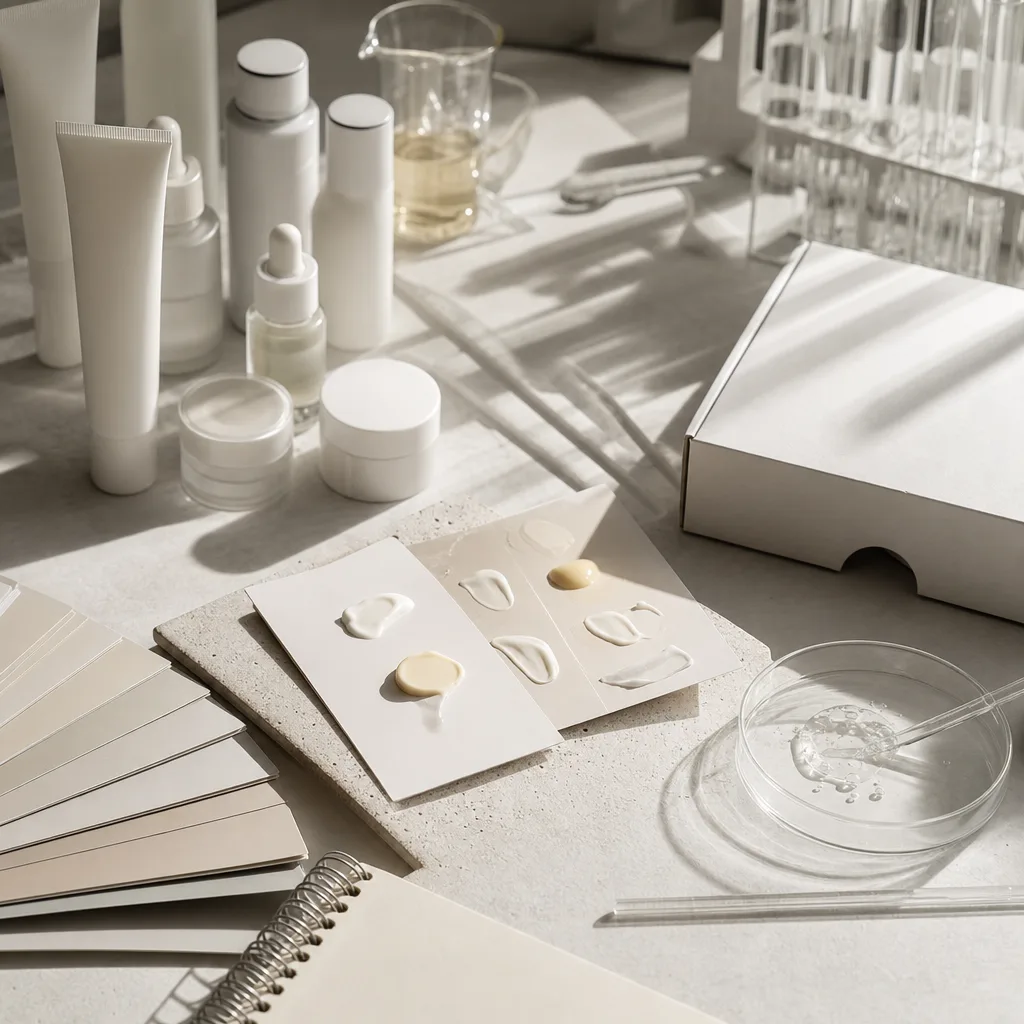
02 · IdentityCore Elements of Brand Identity: Visuals, Story, Packaging, and Customer Experience
So, what constitutes a brand identity that ultimately turns into a product? It breaks down to four main pillars. Although consumers typically ask about logo, typography, Color palette and packaging the most; add brand story and consumer Experience, and then the identity is complete.
1. Visual identity: logo, typefaces & colors
Your logo and typeface need to remain legible on smaller containers. Thin serif typefaces tend to blur on products with limited print areas — i.e., an ampoule with 15 ml volume or lipstick. Prepare an additional reduced version of your logo. With regard to Color, a single pantone reference code is insufficient. Each type of material used in packaging reproduces the same ink differently. Obtain sample Color tolerance packs for each material from your OEM manufacturer and negotiate acceptable limits prior to Production.
2. Brand story
Your story tells potential customers why this brand exists. Perhaps it relates to your personal skin concern, your commitment to use certain ingredients, or your ability to provide solutions for a specific demographic segment. A story becomes stronger when it correlates to the formula. If you are promoting yourself as a brand for sensitive skin, support this claim with verifiable facts: is the product fragrance free? Which preservative system did you select? Did you perform skin irritation tests?
3. Packaging: dividing tasks between primary & secondary packages
- Primary packages (containers): this container comes into direct contact with the product. Along with communicating the essence of the brand, it needs to pass compatibility tests with the product.
- Secondary packages (cartons): this is responsible for creating the appearance of your products on shelves and creating an unboxing Experience for consumers. Additionally, secondary packages provide sufficient space to post required labeling information.
4. Consumer Experience
The amount of dose dispensed by pumps; the noise made by caps closing; the scent perceived by users; and how quickly textures absorb are all aspects of the brand Experience. E-commerce product pages, social media graphics, retail displays, and even boxes shipped to consumers should contain consistent Color systems and verbal tones. Consumers perceive that they are interacting with the same brand throughout each interface. In fact, establishing a single set of brand guidelines for both designers, manufacturers, and e-commerce teams creates consistency across interfaces.
03 · PositioningPositioning Strategy: Luxury vs Clinical vs Everyday Accessible
Once you’ve established your core elements of branding, you’ll need to determine where you intend to place your brand in the marketplace. Whether to develop a Luxury, clinical or everyday accessible brand is primarily a Design issue but is equally an issue related to costs and formulations.
The three Positioning strategies
| Positioning | Examples | Promises | Implications for specifications |
|---|---|---|---|
| Luxury | Augustinus Bader, dior beauty | status symbols; identity; sensory experiences | Heavy Glass containers; soft-touch coatings; embossed logos; premium ingredient narratives |
| clinical | brands focused on active ingredients like the ordinary | ingredients; evidence | ingredient concentrations; efficacy test data; minimal label requirements |
| everyday accessible | skin-friendly brands like glossier | comfortable daily experiences | reasonable-cost Tubes; pe containers; gentle formulations for broad user bases |
Steps to determine your Positioning decision
- Reverse engineer your target retail price to your cost structure. Attempting to utilize Luxury specifications at a low retail price eliminates margins. Utilizing generic containers for high priced products precludes justification for prices.
- Verify if you possess evidence for your claims. Clinical Positioning relies heavily upon efficacy claims. Thus, there are very strict regulatory standards for efficacy claims. In europe, general criteria for cosmetic claims (Commission Regulation (EU) no 655/2013) require honesty and supporting evidence. Similarly strict standards exist in other countries — therefore begin planning your efficacy testing simultaneously with formula development early on.
- Review your distribution channels. Department stores and duty-free locations fit Luxury positions best; drug store locations and online marketplaces fit clinical and everyday positions best.
Once chosen, Positioning is incorporated into container molds, ingredient levels and label copy — thereby limiting flexibility to change your Positioning decision later. That’s why we suggest conducting a cost estimation simulation with your OEM manufacturer prior to beginning Design concept creation.

04 · DifferentiationDifferentiation Ideas: K-Beauty Ingredients, Inclusive Messaging, and Sensory Styling
After identifying your Positioning Strategy — determining how you stand out among numerous competitors positioned similarly. According to Google’s AI Overview — specialized ingredients, inclusive language used on packaging/product communications and sensory-based graphic directions are three strategies that can differentiate brands. Below are how these three differentiation strategies appear from a manufacturing standpoint:
1. Procurement of specialized k-beauty ingredients
K-beauty excels because it has been able to utilize specific ingredients over years. Examples of representative ingredients and their inci names include:
- Snail secretion filtrate — moisturization/skin conditioner
- Centella asiatica extract — signature ingredient for soothing concepts
- Rice extracts/ferments (Oryza Sativa family) — brightening/texture refinement concepts
- Panax ginseng root extract — compliments anti-aging concept
The key factor in differentiation isn’t simply naming an ingredient — it’s explaining the source and concentration of that ingredient. Once you incorporate the supplier’s COA (certificate of analysis); origin; and inclusion rate into your brand narrative — you’ve moved beyond “we also have centella.” Some ingredients are prohibited based on Sales location — therefore research them prior to utilizing them.
2. Creating inclusive language based upon self-acceptance
As stated previously in this section — Google’s AI Overview states that the industry is transitioning from attempting to hide imperfections toward self acceptance/natural improvement. Therefore, in order to represent these ideals in your products — consider offering shades representing diverse skin types/tones — formulate a second low irritant option for sensitive skin — demonstrate applying the product instead of using exaggerated before-and-after photographs.
3. Designing products that create sensations/rituals
Design that emphasizes restraint — natural lighting — close-ups of textures are gaining popularity. This type of Design cannot solely be achieved through photography — therefore you must ensure that the formula will photograph appropriately: a cream with visible texture/body — a gel with actual clarity — a pump with a pleasant tactile sensation. Therefore, consider evaluating samples as part of formulating for how the texture will photograph during the Formulation stage.
05 · ManufacturingTurning Brand Identity into Product: The OEM and Private Label Manufacturing Process
When you take your developed identity and position (differentiation features) and turn them into a physical product, you’re creating OEM manufacturing for the brand owner. Typically OEM manufacturing is done every day by original equipment manufacturers.
STEP ONE: Establish a Brief
Take all elements you’ve decided upon and place them together in one document. Examples include: Performance/Efficacy, Container Size/Format (Serums, Toners, Moisturizers etc.), Skin Feel, Fragrance Status, Target Retail Price, Countries you’ll sell in, Target Launch Date. The countries you will sell in must be determined at this point. Each country has its own ingredient regulations. Failure to determine country of sale prior to commencing development may result in costly reformulations later on.
STEP TWO: Develop the Formula and Prepare Samples
Based on the brief, the manufacturer modifies an existing tested formula or develops a new one. The manufacturer then provides samples of the formula. Normally samples undergo several rounds of revisions. The more specific your feedback regarding skin feel and scent, the less likely you’ll need additional rounds of samples. Instead of “a little lighter,” describe “thin and doesn’t get sticky after absorbing.”
STEP THREE: Stability and Compatibility Testing
After completing revisions, the final formula is subjected to stability testing during varying temperatures and compatibility testing with the intended container. These tests confirm the formula does not discolored nor react with the packaging material resulting in leakage. Omitting this step will undoubtedly negatively affect brand reputation due to quality issues post-launch.
STEP FOUR: Determine Packaging Specifications
You can select either soft-touch coating (premium feel, susceptible to staining and scratching), embossing/debossing (adds visual interest to cartons, individual die charge required), or premium labels (metallic stock, clear labels subject to testing on curvatures and adhesives). Remember, with each added finish the unit cost increases and minimum order quantity also increases.
STEP FIVE: Create Label and Begin Production
Label artwork is completed and reviewed. Upon completion of the review process, production begins through purchasing components, filling, packaging and inspection for outgoing shipment. When working with an OEM manufacturer verify they adhere to ISO 22716 (the International Good Manufacturing Practices Standard for Cosmetics). Several countries utilize ISO 22716 as a quality management benchmark.

06 · LocalizationLocalizing Your Brand for Multi-Country Launches: Labels, Certifications, and Local Aesthetics
Upon completing production of the product, a final review takes place based on the countries where you plan to enter. Brands planning on entering multiple countries should identify early in the process which aspects of the product remain consistent and which can change.
Consistent Aspects of the Product
In general, brands should maintain consistency among logos, primary color(s) and signatures colors, package shapes and forms, brand names and fundamental concepts related to formulating the product across countries. If you deviate significantly among these areas customers shopping globally online and using social media may not recognize them as being part of the same brand.
Aspects That Change by Country
1. Multilingual Labels with Required Data
Each country defines which language(s) must appear on product labeling. Each country also identifies data that is mandated for display. In the European Union, the Cosmetics Regulation (Regulation (EC) No 1223/2009) mandates identifying a Responsible Person in each designated territory and filing notification with CPNP. In addition, ingredient listings must occur via INCI nomenclature. In the United States, the Modernization of Cosmetic Regulation Act (MoCRA), enacted in 2022, requires registering facilities and listing products. Countries within the Gulf states (such as Saudi Arabia and the U.A.E.) require Arabic labeling for products sold locally. Products sold in Saudi Arabia must also be filed with the SFDA.
2. Ingredient Regulations/Certifications
An ingredient could have restrictions on allowable concentration limits or prohibited uses in various countries. In certain regions of Asia, halal certification is an important factor influencing distribution channels and consumer purchasing behavior. Halal certification assesses origin of ingredients as well as control of production lines, therefore it is best to address this with your OEM manufacturer early in the process.
3. Visual Design/Aesthetic Tones Matching Regional Sensibilities
Maintain the basic design aesthetic of your brand while allowing flexibility in marketing model images/color tones/message focus for local aesthetics preferences. For example, a moisturizer cream designed for long lasting hydration may emphasize long lasting hydration for dry climates while emphasizing a lightweight texture for humid climates.
Developing with Your OEM Manufacturer
Developing a common formula that satisfies regulations in multiple countries simultaneously offers a significant advantage in terms of efficiency. Also by leaving open space on the carton for multilingual data or defining an area for country-specific sticker labels, you can implement a single formula/container strategy and merely swap labels to accommodate multiple markets. While competitor content infrequently addresses this topic, it has possibly the greatest impact on determining launch timelines/inventory levels.

07 · ChecklistBeauty Branding Checklist: A Step-by-Step Template from Planning to Launch
Below is a checklist to help organize your thoughts when developing your project. There are few templates available that are pre-formatted specifically to fit beauty branding. Use these items as-is in whatever project management tool you prefer.
1. Research
- Identify your target customers’ skin concerns/concerns, age range/purchasing channels
- Verify countries you intend to sell into
- Compare competitive products in same price range – ingredients, containers, pricing
2. Positioning
- Select either Luxury/clinical/daily usage positioning
- Establish target retail price/target cost ratio
- Outline efficacy claims made/make sure claims match facts (testing plans etc.)
3. Visual Identity
- Main logo + smaller version for smaller containers
- Color Palette and samples of acceptable color tolerance for materials
- Write Brand Guidelines Document
4. Development/Finalize Product Formula
- Send Brief to OEM manufacturer (performance/effectiveness/format/scent/countries)
- Evaluate samples – Sample Evaluation Sheet – Log Feedback
- Research ingredient requirements for each country where you plan to sell
- Conduct stability/compatibility testing
5. Packaging: Minimizing Costs vs Order Quantities
- Determine whether to choose stock containers/custom molds. Stock containers are generally less expensive upfront/cost per unit/minimum order quantities whereas custom molds allow for greater differentiation but increase mold costs/lead times.
- Review how many finishing options (Soft-Touch, Embossed, Foil) you elect to apply to your product and their effects on overall unit cost.
- Estimate conservative first production run numbers compared to your projected sales forecasts.
6. Prepare for Launch
- Final review of all multilingual label information/artwork
- Register/product notify in applicable countries (e.g. EU CPNP; USA FDA listing; SFDA-Saudi Arabia)
- Ensure global e-commerce sites/social media/retail promotional materials convey consistent tone
- Coordinate logistics/warehouse receiving/outgoing inspections

08 · FAQFrequently Asked Questions
Short answers to the questions brand owners really ask.
What is the best way to start when building a beauty brand from scratch?
Determine your target customer, sales countries and retail price before deciding on logo. With those three set, you will be able to decide positioning, formulation and container specs. From there, send a brief to an OEM or private label manufacturer and begin sampling.
Do I launch skincare, haircare, or makeup first?
You are most likely going to launch in the category that most directly relates to your brand story. Skincare allows for telling ingredient stories and has a repurchase cycle. Makeup multiplies SKUs by the number of shades which increases initial inventory burden.
How do I make my brand look premium?
Restraining yourself (not adding decorations) matters more than adding decoration. A limited color palette, typography with space between lines, a weighty container and a finish that feels good in hand create quality that you feel. Remember each added finish increases unit cost and minimum order quantity so prioritize.
How do I write a brand story that sells?
Connect your founding motivation, the skin concern you want to solve and the ingredients and formula that will solve it all together into one single narrative. Every claim you make in your story must be backed up by verifiable evidence like the ingredient list or testing data.
How do I stand out in a crowded market?
Develop differences based on what the product can show as proof: the origin and concentration of k-beauty ingredients; inclusive shade ranges and low-irritant formulas; and textures that provide real sensory experiences. Differences created solely through design can be easily copied.