Why You Must Check Market-by-Market Distribution Exclusivity First
Being able to source Korean cosmetics at wholesale in the UAE and being able to redistribute that volume into individual Gulf markets are two very different things. That is exactly why this korean beauty wholesale guide does not begin with “is UAE wholesale open?” but with a sharper question: “does an exclusive distributor already exist in the market I want to sell into?”
The core issue is the Gulf exclusive-agency structure. GCC states, including the UAE and Saudi Arabia, grant strong legal protection to a registered exclusive agent through their Commercial Agency Law. If a brand has registered an exclusive distributor in Saudi Arabia, then even if you secure that same brand at wholesale in the UAE, the parallel flow of that stock into Saudi can be blocked contractually and legally. Registered agents often hold the right to object to non-registered stock at the customs stage, so the “I sourced it but it’s stuck at customs” scenario genuinely happens. In other words, customs and logistics are not simple operational variables — they are legal variables that depend on whether distribution rights have been registered.
That makes the pre-order checkpoint simple: (1) does the brand you want to trade hold an exclusive distribution contract in your target country (UAE, Saudi, Kuwait, etc.); (2) does that contract cover wholesale, resale and online sales; and (3) does the channel you can secure conflict with that exclusive scope? Until these three are confirmed, negotiating MOQ, wholesale price or shipping can be meaningless. This guide fixes that pre-check as step one.
Competing suppliers push scale metrics — door-to-door customs handling, 550+ brands, shipping to 100+ countries — as their differentiators, yet they leave the prior question (“do country-level distribution rights conflict with my order?”) unanswered. Comparison resources such as Top Korean Skincare Wholesale Suppliers also cover MOQ, authenticity and assortment, but not market-by-market exclusivity conflicts. No matter how strong the scale and customs capability, if a registered exclusive distributor exists in your target market, that brand-country combination should be dropped from consideration from the outset. The sections below show how to actually verify exclusivity, then walk through customs, certification, MOQ and logistics checkpoints in order.

Pre-Order Checkpoints for Gulf Exclusive-Distributor Status
When bringing Korean cosmetics into the UAE or Saudi Arabia, do not assume that “UAE wholesale is possible” means you can freely handle every brand. If a brand has signed an exclusive distributor agreement in a Gulf country, parallel wholesale may be blocked or rejected at the customs stage in that market. Before you write a purchase order, verify Gulf distribution rights in the following sequence.
Step 1 — Confirm exclusive-distribution contracts brand by brand. For the brands that appear across most top wholesaler catalogs (COSRX, Beauty of Joseon, AXIS-Y and so on), check whether a registered exclusive distributor exists in the UAE or Saudi Arabia. You can verify this not only through brand headquarters or regional sales teams but also through an authorized distributor in Korea — authorized distributors understand each brand’s Gulf distribution structure and will often point you directly to the official local distributor when one exists in a given country. To gauge which brands can ship to the Gulf, you can use the handling list of a multi-brand supplier such as umma as a reference baseline.
Step 2 — Be aware of local commercial-agency law. The UAE protects government-registered exclusive agents through its federal Commercial Agencies Law, and Saudi Arabia does the same through the Saudi Commercial Agencies Law. Where a registered agent exists, parallel imports and wholesale of the same brand may be restricted, and customs clearance may be refused without the registered agent’s consent. Unlike competing wholesalers that simply tout “customs handling” or “multi-country shipping,” whether a Saudi distributor is registered is a variable you must check first at the statutory level.
Step 3 — Confirm country-level export eligibility in one pass with an authorized distributor. Because real orders usually bundle several brands at once, it is more efficient to ask an authorized distributor in Korea all at once than to track each brand separately. The authorized distributor can compile, brand by brand, whether “this brand can be exported and sold into the desired country (UAE/Saudi).” Some suppliers publish this information by country on their websites, but posted information updates slowly and can diverge from the real rights status — even a supplier advertising 100+ country shipping such as q-depot may have specific brand-country combinations blocked, so the most accurate approach is to obtain final confirmation in writing from the brand headquarters (or authorized distributor) and keep it on file.
Step 4 — Map alternative routes. If exclusivity is in place, compare three routes — (a) re-wholesaling through the registered local distributor, (b) securing an equivalent alternative brand with no exclusivity, and (c) bypassing via OEM / private-label production — so that supply is not interrupted even if one brand is blocked.
Clearing these checkpoints before trade negotiations begins lets you pre-empt the risk of paying and shipping under the assumption that wholesale is open, only to be rejected at Gulf customs.

Country-by-Country Customs — A Duty-Free Door-to-Door Guide
The UAE and Saudi Arabia belong to the same Gulf Cooperation Council (GCC) customs union, but actual clearance procedures differ by country. Buyers who order on the strength of the phrase “duty-free door-to-door” alone often see shipments stall at the port because duty, VAT or certification requirements were missing at the import stage. This section sets out the country-level customs flow for bringing Korean cosmetics into the UAE and Saudi Arabia, based on official standards.
The reality behind “duty-free door-to-door” — DDP terms. For door-to-door to carry real value for a buyer, the supplier must not merely ship but operate under DDP (Delivered Duty Paid) terms, pre-bearing duty, VAT and clearance fees and accompanying the goods with a certificate of origin, ingredient list and Certificate of Analysis (C.O.A.). The point is not the phrase “duty-free” itself but who bears the duty, tax and certification responsibility at which stage.
Country-level customs checkpoints.
- Pre-classify the HS code → forecast duty rate and VAT
- UAE: Dubai Municipality product registration + confirm Free Zone routing
- Saudi: secure SFDA notification + GCC conformity certification
- Prepare commercial invoice, certificate of origin, ingredient list and C.O.A. in advance
- Clarify Incoterms (DDP vs CIF/DDU) to prevent cost and liability disputes
This guide is built on the public clearance and registration standards of Dubai Customs, the UAE federal customs authority, and Saudi ZATCA and SFDA. When selecting a supplier that advertises door-to-door, we recommend confirming the checkpoints above in writing at the quotation stage.

Certification & Authenticity Assurance — C.O.A., CPNP, Halal, FDA
For Gulf (UAE / Saudi) buyers to clear and resell Korean cosmetics safely, regulatory paperwork governs shelf entry as much as the product itself. In practice, assembling the right documents by country and item is closer to the real burden wholesale must shoulder than the act of importing the goods. This section organizes the key evidence from a buyer’s ordering perspective and corrects common market misconceptions about the status of Halal and FDA.
C.O.A. authenticity certification (Certificate of Analysis) — a per-batch test report covering ingredients, microbiology and heavy metals. Gulf customs and local distributors routinely require authenticity and quality evidence, so we provide brand- and batch-level C.O.A. alongside the order to lower the risk of clearance rejection. Some global wholesale platforms enclose a C.O.A. per order to guarantee authenticity (umma.io, for example), so we recommend confirming per-batch issuance in writing before ordering.
CPNP — what it is and what it is not — CPNP is a pre-notification scheme under the EU Cosmetics Regulation (Regulation (EC) No 1223/2009), premised on a designated Responsible Person, labeling and a Product Information File (PIF). A track record of clearing the EU is a quality signal to Gulf buyers, but CPNP itself does not simplify or waive local UAE or Saudi certification procedures. Since the EU and the Gulf are separate regulatory zones, CPNP should be used only as a supporting trust signal, and local clearance requirements must be met separately. Platforms that put EU regulatory compliance (CPNP / EU labeling) front and center (miintrade.com, for example) share the same limitation.
Factory-level certification — CGMP or ISO 22716 — Gulf buyers and local distributors often request either CGMP (Cosmetics Good Manufacturing Practice) or ISO 22716 for the manufacturing plant. You do not need both — meeting just one of the two satisfies the manufacturing-credibility requirement. We confirm in advance the factory certification a handled brand holds (whichever of CGMP / ISO 22716 it has) and state it clearly to buyers.
MSDS — a mandatory document per item — the Material Safety Data Sheet (MSDS/SDS) is required for every individual item, demanded at the transport, customs and warehousing stages for flammability and chemical-ingredient information. Alcohol, aerosol and some liquid products can have shipment itself delayed without an MSDS, so we prepare a per-item MSDS at the ordering stage.
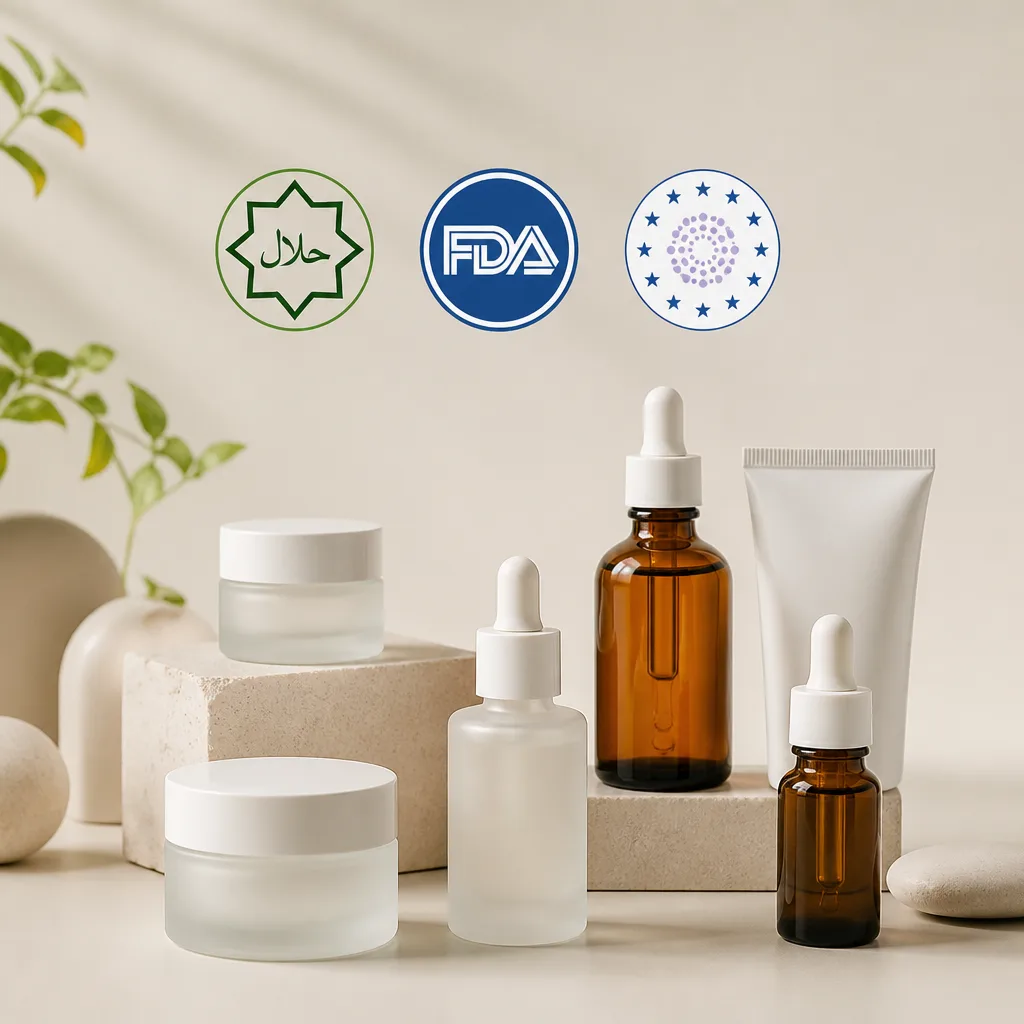
Halal and FDA — correcting common misconceptions — there is a widespread belief that “Halal certification is mandatory for Gulf export,” but it does not apply that way to cosmetics. Halal’s mandatory scope works essentially around food taken into the mouth, and leave-on cosmetics are not required by the UAE or Saudi Arabia as a mandatory clearance/registration document. A Halal mark is therefore a marketing and trust signal aimed at Muslim consumers, not a gate that opens or closes customs (in some buyer channels sensitive to alcohol or animal-derived ingredients additional requests may arise, which we pre-empt with an ingredient list and MSDS). The actual mandatory procedures are separate — the UAE requires MOIAT’s conformity assessment (ECAS) and product registration, and Saudi Arabia requires SFDA cosmetic pre-registration (notification). Meanwhile, the US FDA cosmetics framework and 2022 MoCRA (facility registration / product listing) can signal technical and quality credibility, but are not a factor in deciding Gulf export eligibility. They become an optional checkpoint only for buyers who also pursue a US sales channel.
Buyer checklist — ① per-batch C.O.A. issuance availability, ② factory CGMP or ISO 22716 certification (one of the two) confirmed, ③ per-item MSDS prepared, ④ UAE / Saudi local mandatory registration (MOIAT/ECAS · SFDA) requirements, ⑤ recognize that Halal is a marketing/trust signal rather than a mandatory document and does not govern customs (secure an ingredient/raw-material evidence path on request), ⑥ recognize that FDA and CPNP are supporting signals only and do not replace Gulf export or local certification. Agreeing these items with the supplier in writing before ordering cuts the hidden costs that arise at the clearance and resale stages far more than price negotiation does.
MOQ, Minimum Order Value & Payment Options at a Glance
To estimate ordering cost before a buyer makes a first inquiry, check two axes first — (1) the minimum-order baseline (MOQ / minimum order value) and (2) the available payment options. One premise should be clear, though: because many authentic brands require proof of a clearly identified buyer (business registration, trading history and similar documentation) for wholesale supply, specific brand-level wholesale prices are provided to buyers who have completed identity verification. Instead, we share the MOQ tier structure and representative unit-price examples below in advance, so you can estimate your first order size yourself even before a formal quote.
MOQ tier structure. Synthesizing public industry signals, the entry band starts around the $1,000 level, and real orders are commonly set from $3,000. Exceeding $5,000 per brand typically moves you into an additional bulk-discount band, and $10,000 and above converts to a custom quote — a tiered structure is common. Many suppliers also take orders by the box (1 box = N units), so the practical MOQ per SKU varies with box composition. Sharing this tier skeleton in advance lets a buyer design brands and quantities against a target order value even before receiving formal prices after identity verification.
Pre-calculating cost with example wholesale prices. To help gauge first-order size, here are representative item wholesale-price examples: COSRX Advanced Snail 96 Mucin Power Essence 100ml $16.80, COSRX Acne Pimple Master Patch 1ea $3.50, AXIS-Y Dark Spot Correcting Glow Serum 50ml $25.00, The Ordinary Niacinamide 10% + Zinc 1% 30ml $7.31, Beauty of Joseon Relief Sun 50ml $18.00. Multiply these unit prices by box composition and target order value to back-calculate the quantity needed to meet the MOQ. (Actual applied prices follow the brand-level wholesale price provided after identity verification.)
Payment options. Wholesale trade on this site proceeds by bank transfer (T/T); card payment is not accepted. UAE and Saudi buyers should factor remittance fees and exchange-rate movement into total cost when sizing their order. A single bank-transfer method also leaves a clear transaction record, which helps align B2B settlement with customs documentation.
In short, presenting three things clearly — ① a policy of providing formal wholesale prices to identity-verified buyers, ② a tiered MOQ skeleton anyone can preview ($1,000–$3,000 entry → $5,000+/brand bulk discount → $10,000+ custom quote), and ③ a single bank-transfer payment — lets buyers quickly gauge first-order size within a trustworthy trade structure.
Logistics, Shipping & Local Warehousing — UAE & Saudi Cases
For Gulf buyers, shipping speed and local stock location are purchase-decision factors as important as unit price. Global wholesale platforms already put processing time front and center. Hand-picked, brand-focused suppliers list 48-hour dispatch (U-Quick) on flagship SKUs and shipping to 150+ countries (umma), while a Europe-based supplier advertises 24–72 hour processing from its Barcelona warehouse (miintrade). The shared message of both models is clear — “where the stock sits” governs lead time.
That said, their warehouses skew toward Europe and Asia, so from a UAE or Saudi buyer’s standpoint time can stretch back out at the last-mile and customs stages. Fast “dispatch” does not mean fast “arrival.” This guide narrows the core market to the Gulf and checks logistics by “total lead time to arrival,” not processing speed.
Gulf logistics is most accurately checked in three stages.
- Dispatch and air transport — air cargo from Incheon to Dubai (DXB) or Riyadh (RUH) on direct routes is typically 1–3 days. Cosmetics are classified as general IATA cargo, and flammable ingredients such as high-content alcohol toners require prior MSDS verification.
- Local customs — the UAE allows duty-free storage when goods enter Free Zones such as Jebel Ali or Dubai South, with the common GCC duty arising at the point of entry into the mainland. In Saudi Arabia, SFDA cosmetic registration and SABER conformity certification must be completed before clearance to avoid delay.
- Last mile — within central Dubai and the Riyadh area, delivery within 24–48 hours of clearance is realistic when a local 3PL is connected.
So rather than simply comparing “dispatch within X hours,” buyers should also ask about ① whether bonded / Free Zone stock is operated, ② whether SFDA / UAE customs documents are packaged before dispatch, and ③ whether a local 3PL is connected. With these three in place, the business days from order to Gulf arrival can be shortened the most for registered items.
In short, the differentiator from global suppliers that advertise fast dispatch is managing “total lead time including Gulf clearance.” Tying warehouse location, advance certification documents and local 3PL connection into one flow — designing logistics around UAE and Saudi buyers’ actual receipt date — is the key.
Supplier Selection Checklist & Buyer FAQ
Here we organize the key items a buyer should check before settling on a Korean cosmetics wholesaler, as a checklist and FAQ. This procedure is not a simple price comparison but a way to verify market-by-market distribution rights, customs, authenticity and payment all at once. The K-beauty wholesale market is projected to grow to roughly $13.9 billion by 2027 (Allied Market Research), so a supplier comparison must look not only at price but also at regulatory compliance.
Supplier selection checklist
- Market-by-market distribution exclusivity — before ordering, confirm whether the brand holds an exclusive-distribution contract in the UAE or Saudi Arabia. In some Gulf countries, a local distributor can restrict parallel wholesale of the same brand.
- Minimum order value (MOQ) — whether the brand/order-unit bands are disclosed in advance. The industry norm is roughly $1,000–$5,000 per brand, with additional bulk discounts applied above a certain amount.
- Customs handling — requirements differ by import form (free zone vs mainland supply). Confirm whether the supplier advises and supports the documents, costs and timelines for free-zone-only entry (e.g., JAFZA / DAFZA), UAE mainland distribution, and each Saudi shipment.
- Authenticity and certification — provision of per-order C.O.A. (authenticity/ingredient analysis) and meeting destination-country registration requirements.
- Payment options — variety such as bank transfer, Wise and credit card.
- Logistics and lead time — local warehouse presence or average shipping days. Add the time for clearance registration and certification issuance into the lead time in advance.
Buyer FAQ
Q. How do I order? It proceeds in four steps: quote request → invoice confirmation → payment → customs and shipping. For a first transaction, we recommend requesting the catalog and price list first to confirm the MOQ.
Q. How is customs handled? The procedure changes greatly by destination country and import form, so do not treat it as one bundle.
Be sure to confirm whether the supplier supports issuing these registration, COC and labeling documents, and whether cost and timeline are included in the advance quote.
- UAE — free-zone entry: when goods are brought into a free zone (JAFZA, DAFZA, etc.) in Dubai for storage and re-export only, separate product registration is effectively unnecessary.
- UAE — mainland supply: to distribute and supply the same product outside the free zone, i.e., into the UAE mainland market, the product must be registered in the Dubai Municipality / Ministry of Health and Prevention (MOHAP) system. In other words, “entry” and “sale” have different requirements.
- Saudi — COC per shipment: Saudi Arabia requires, for every export and all volumes, a conformity certificate (COC, on the SABER/SALEEM platform) from a SASO-accredited inspection body before clearance. Because COC issuance cost varies with export volume and item, confirm the cost before each shipment and factor the issuance time into the lead time in advance.
Q. What certifications are needed? EU CPNP registration applies for re-export to Europe, Halal certification for Muslim-market targeting, and FDA requirements for the US. Rather than relying on a competing wholesaler’s “certification labels,” it is safer to choose a supplier that directly meets the standards of each country’s official regulator (Saudi SFDA/SASO, UAE MOHAP, EU CPNP).
Q. What is the minimum order value? It varies by brand and catalog, typically starting from $1,000. Box-unit ordering (1 box = N units) is also common, so confirm the unit conversion as well.
Q. What are the payment and shipping options? We provide international payment such as bank transfer and Wise, and mixed air/sea logistics; routing through a UAE or Saudi local warehouse shortens lead time. Just plan the overall schedule with the customs registration and COC issuance time above included.