From concept to shelf: a field-tested OEM, ODM and private-label playbook for global B2B founders launching a K-beauty skincare brand.
Building a brand from concept to shelf involves manufacturing, Negotiation, regulation and design. This guide walks global b2b Founders through each stage of building a brand from concept to launch with figures and field notes from real k-beauty oem and ODM projects.
01 · OEM, ODM & Private Labeloem, ODM and private label – what is the Difference?
The first decision that most everyone who is searching for how to start a skincare line will need to make when they are determined as to which model of manufacturing they want to use is who owns the formula. Almost all searchers for this term are prospective brand owners rather than shoppers buying finished products. So, this single decision affects cost, speed and differentiation at the same time. Here is how the three models compare.
| Model | Definition | who owns the formula | differentiation | initial cost & speed | best for |
|---|---|---|---|---|---|
| oem | the brand provides the formula and concept; the factory produces it as specified by the brand | brand or co-development | high down to ingredients and feel/texture | higher cost, slower production | Brands who plan on differentiating their product through unique ingredients or process |
| ODM | the factory has an existing formula; the brand applies its label to it | factory | medium, mainly scent/color/Packaging | Fastest and cheapest option | founder prioritizing speed and validation |
| private label | a standard completed product receives your label | factory (finished goods) | low, only the label and container | Fastest and cheapest option | Retailers filling out a full lineup quickly |
The trade-offs between these choices can not be shown clearly on a table but they help.
Private label is the easiest way into the marketplace. It is the quickest way to get Samples made and the most flexible on minimum order quantity (MOQ). It is also the most efficient way to test the market at low cost. Since the product is essentially identical to an existing standard item however, long term competitiveness fades. Later entrants can launch the same finished product with just a new label, so the product itself does not create any barriers. Competition then moves off of the product and onto who markets better and who secures stronger sales channels.
ODM delivers fast as it uses the factory's existing formula but the result depends heavily on whether the factory has good formulation control and process management. Moreover, even if you successfully develop your product with ODM, you are still tied to that one partner as they keep ownership of the recipe. Factories also have a hard time making changes beyond minor tweaks to scent or color, so real customization often happens only at the Packaging and surface level.
Oem is the most demanding. You must communicate at the formula level and judge ingredient trend and compatibility well enough to bribe them, which is demanding for a first-time founder. Yet for a brand that plans to last, oem is the stronger choice. A proprietary formula is very difficult for followers to copy and consistant concept build an image that competing Brands have truble crossing over.
Yet for a brand that plans to last, oem is the stronger choice.
On building a lasting K-beauty brand
In practice these three blend instead of split cleanly. Many Brands build one or two hero products using oem to set identity and then fill out the rest of the lineup with ODM and private label for launch speed. Bigger Brands show a sharper pattern: knowing that product differentiation is really where the barrier to entry exists, they rarely use private label, run most lines on oem from their own labs, and use ODM only for some support lines. The choice comes down to three axes: do you need to differentiate at the formula level?, how much capital do you have available to spend now versus your target date for launch, and how much direct responsibility will you carry for regulatory issues? The sections below cover the roadmap after this decision, including choosing a manufacturing partner, selecting a factory, Negotiation, and branding.
02 · Roadmap to LaunchStep-by-Step roadmap to launch a skincare brand
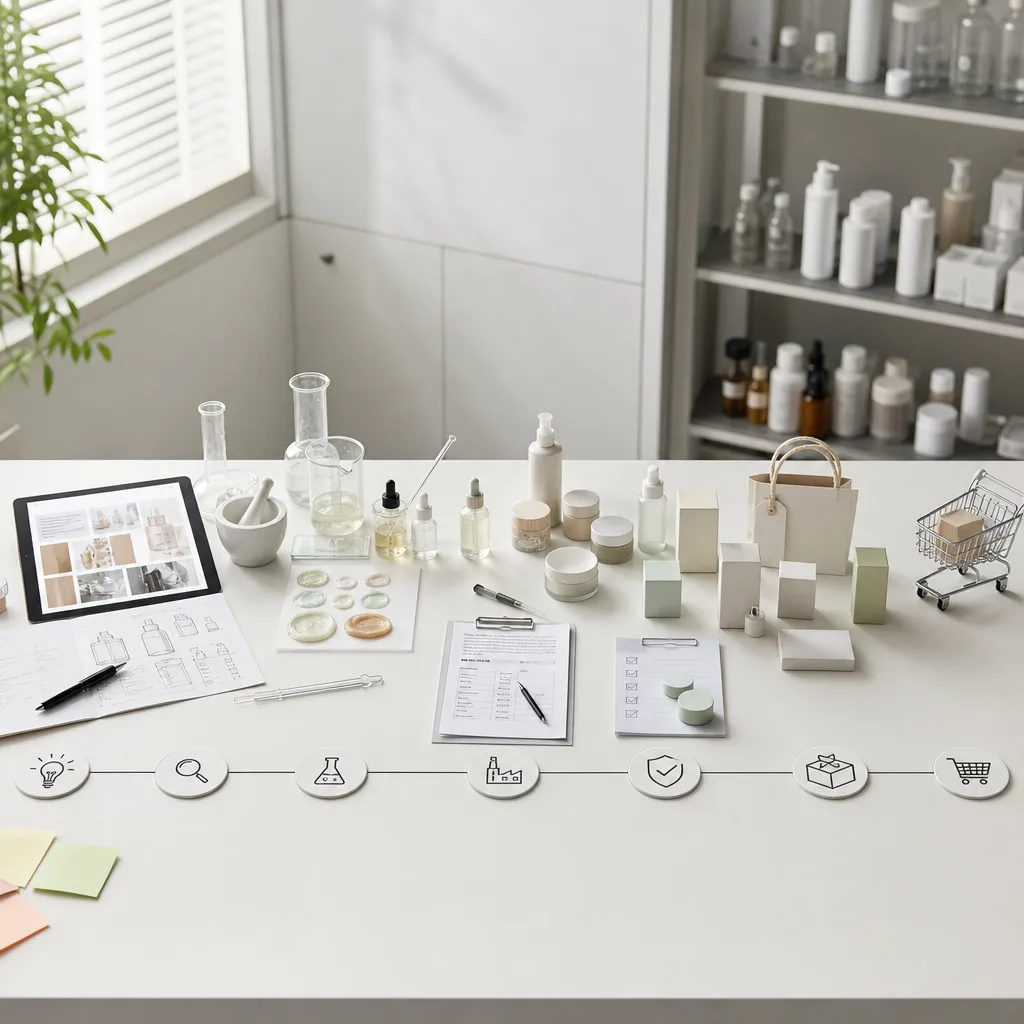
Once you have chose your model for manufacturing you need to follow this roadmap from concept to launch. Because searchers want to know how to start, not where to buy, this roadmap is something a global b2b founder can follow directly.
Step 1 — define concept & positioning
Lock your target market (global, Middle East, Southeast Asia), price tier, and core efficacy axis (hydration, soothing, brightening) into a sentence. That one sentence becomes the reference point that aligns all other later formula, package and regulations decision.
Step 2 — select category & core SKUs
Select which 2-4 SKUs you will actually need at launch such as toner, serum or cream. Additional SKUs before seeing market response creates high MOQ pressure and inventory pressure, so usually it is wise for a first-launch of one to two SKUs. Expand after you see market response.
Step 3 — set formulation direction
For oem, set your key active ingredients and rough concentration direction. For ODM shortlist your options from the factory's existing formulas. Framework ingredient names and concept in language understood by the factory greatly reduce development round-trips.
Step 4 — pre-check regulation, certification & document availability
Confirm whether you can meet each target country's cosmetics regulations requirements such as GMP and whether the factory can supply the documents needed for import/customs clearance and registration in that market. There is a reason this is done before partner selection; if there are problems with documents you may not ever be able to change that. Discovering regulatory or document issues after locking in your formula will be expensive to redo.
Step 5 — select manufacturing partner & sample
Evaluate qualifications, Equipment & communication then request Samples from multiple factories (see next section). Select only those factories that passed the document check in Step 4.
Step 6 — Finalize Packaging & labelling
Finalize labels & containers that meet all market required elements. Plan lead times cautiously: as of June 2026 in Korea containers take about 5-7 weeks and while Packaging production it self is short, approving design often takes longer than expected. Starting early on design is key to holding launch date.
Step 7 — Pilot production, QA & launch
Run Pilot batch before mass production verify stability, appearance & markings then launch.
03 · Choosing a Partnerchoosing a manufacturing partner (OEM Factory)
Choosing a manufacturer effectively decides your brand quality. Instead of trying to find a general "good factory", compare your potential candidates against a check list based on objective criteria.
certifications & quality systems
first confirm iso 22716 (international cosmetics GMP standard), ISO 9001 for quality management and if required by target markets, FDA registration. These signals are objective and reliable enough that you should always confirm original certificates with issuing body rather than trust factory descriptions.
track record with global Brands
Choose factories that have already mass produced for global Brands. History of passing established Brands' quality & compliance bars indirectly guarantees process maturity & documentation. Please request references with names of Brands & categories of products & volumes produced.
large vs mid-sized factories
Large companies meet both certification and track record criteria but often have high unit prices that do not fit Founders looking for small run units. In practice, mid-sized factories with comparable scale & quality but less visibility are often more affordable in terms of price per unit, flexibility with small batch orders and communication. Choose the proven factory that matches your sku volume not just whoever is most prominent.
Equipment & capacity
Check if the factory's filling/emlusification Equipment / cleanroom grade / minimum batch size match your SKUs. Small batch multi-product startups and high-volume single-line factories don't usually go hand-in-hand.
communication & documentation
Whether the factory provides formula sheets / inci data / stability reports in standards format will determine how much trust you place in longterm collaboration with that factory.
Again, always order from multiple factories at the same time. Even with same formula/concentration raw material grade/mix order/emulsion differences between factories exists. So finally stability/fill/feel/ssent will vary slightly. Order from only one factory – you will not know if the results are optimal. Getting side by side Samples from two or three different factories then running stability studies (high temperature/low temperature/light exposure) & sensory evaluations let you choose based on quality & republicabilities not just pricing. Where content exists about selecting manufacturing partners only at a superficial level of certifications/Equipment/communication, this same-concept multifactory sampling/comparison is a practical/direct method for separating themselves.
04 · MOQ, Samples & PricingMOQ, Samples, and Pricing Negotiation
Once you have identified some potential sampling sites at a factory you are interested in, terms are considered. The three major factors influencing a new brand's cash flow, based upon their ability to negotiate these items during the term-setting phase, include the manufacturer's Minimum Order Quantity (MOQ), the manufacturer's sample policy and the manufacturer's pricing structure. Recognize that these three factors are tied together, i.e., if a new brand negotiates a lower MOQ, the manufacturer is likely to raise the sample cost or vice versa.
Minimum Order Quantity (MOQ)
The primary reason manufacturers have a Minimum Order Quantity (MOQ) is due to raw-material purchase orders and manufacturing batch efficiencies. Therefore, if you are forced to place an initial order of a quantity greater than your desired product assortment size, select only the necessary products and establish a system to minimize the total number of units required across all products. When using standard or off-the-shelf formulas (referred to as ODM) in addition to proprietary formulas developed by the manufacturer (OEM), it is possible to spread the burden associated with establishing an initial large MOQ.
Sample Policy
Sample policies vary widely among manufacturers. While many manufacturers provide samples for no cost, they frequently incur a cost when developing a custom formula to match the brand owner’s specifications or perform multiple small-scale trial runs. Keep in mind that while the manufacturer incurs an upfront cost related to providing “no-cost” samples, they expect this expense will be reimbursed by future large scale orders placed by the brand owner. Therefore, track the specific line item(s) on which these expenses are incurred. Manufacturers that charge for samples typically lack sufficient resources to support a large-scale contract (i.e. insufficient capacity or capital), thereby increasing risk associated with maintaining consistency in delivery and quality control. As a result, it is recommended that manufacturers that charge for samples should be deprioritized when seeking a global contract for mass production. One of the most critical aspects of obtaining samples relates to confirming that the sample used to develop the product formulation is representative of the production unit (i.e. contains the exact same formulation, is packaged in an identical container, etc.). Failure to accomplish this results in receiving consumer complaints regarding product quality after launching the product. Three things need to be documented prior to initiating production:
- the sample is prepared from the exact same production formulation
- the sample is packaged in an identical container and includes all similar packaging components
- document the lead time associated with receiving the sample
Pricing Structure
Prices provided by manufacturers generally include costs associated with bulk (content), container, and/or packaging components, filling/packaging labor, testing/certification services, etc. In order to determine where prices decrease as volume increases, break down the quoted price by item. There are two ways to achieve economies of scale relative to pricing: 1) a turn-key model whereby the manufacturer provides all elements necessary to fill containers including purchasing packaging components, or 2) a model where the brand owner purchases and owns packaging components and consigns them to the manufacturer for use. Typically, utilizing a model where the brand owner purchases and owns packaging components results in a higher-quality product and lower overall cost since it eliminates an additional profit margin layer and allows brand owners to maintain direct control over design and quality. However, it also requires additional management responsibility. Non-standard packaging components require additional verification of compatibility with the product formulation. Many times, particularly for a new brand or unexperienced team, it is reasonable to rely on a turn-key model to minimize variables at the beginning of a relationship with a supplier and then transition to purchasing and controlling packaging components separately once volume and operational processes have stabilized. Additionally, ensure that there is clarity around how long a quoted price remains valid and what payment terms will apply (e.g. deposit percentage, timing for balance payments) in order to mitigate exchange rate risks and fluctuations in raw material costs. Finally, negotiate pricing on landed cost basis: comparing a single unit price obscures various components involved in getting products delivered to consumers including packaging components, testing/certification fees and logistical costs. Combine MOQ negotiations, sample policies and pricing structures into one quote package, ask multiple factories to respond using identical terms and evaluate responses.
05 · Branding & LabelingBranding, Packaging & Labeling Strategy
After completing all conceptual steps outlined above and determining all applicable regulations affecting your product, your company must make decisions about branding, packaging & labeling to see if markets will choose you. This step represents the last opportunity to differentiate yourself from competitors and where regulatory obligations intersect.
Brand Identity
Express your brand position statement as visually as possible. Align naming conventions, logos, colors, font styles, etc. so a consumer can read your brand identity from the shelf in less than 3 seconds. For a young brand in particular, having a consistent visual element running throughout all of your products will increase recognition rapidly.
Packaging Design
Packaging affects both brand perception and product durability. Products containing oxidation-sensitive ingredients (vitamin C and retinol for example) tend to fare better in opaque packaging systems using airless pumps. Therefore, packaging selection must occur simultaneously with product formula development. Each market also has unique shipping and climatic conditions (hot desert climates such as in the Middle East for example) that impact durability of packaging materials. A frequent oversight related to color occurs when designing a packaging concept: printed cartons & containers appear differently than proofs due to RGB vs CMYK conversion & spot-color variations plus ink absorption characteristics of the container material. Color matching may take significant amounts of time and re-printing costs so budget accordingly. An equally frequent oversight is allowing designers to create an elaborate proof that may be difficult to manufacture or economically impractical. Early involvement of a packaging specialist to review production limitations (mold capabilities, printing methods available, finishing limitations & MOQ-driven costs) will assist in ensuring designs are feasible for production.
Label Requirements
Labeling requirements represent both design elements and legal obligations. Countries require brands to list ingredients (INCI name) for each ingredient contained within their products along with expiration/batch numbering, identification of responsible parties/importers, volume measurements/caution statements with country-specific labeling requirements (e.g. Arabic-language labeling in conjunction with English language in the Middle East and display of responsible-person addresses in EU countries). Depending on whether products sell domestically or internationally in Korea for example; labels may contain different obligatory markings/language/responsible party information. Confirm domestic/international sale channels prior to selecting a packaging configuration to accommodate local labeling requirements. To avoid repeated re-design efforts due to labeling compliance; reserve space for obligatory labeling areas first, then design your branding/logo/description second.

06 · Why an AgencyBenefits of Using a Specialized Agency Over Attempting All Tasks Yourself
As you can now clearly see; defining your product concept/concept definition; identifying suitable suppliers/contractors; negotiating MOQ/Pricing/Samples; identifying/applying relevant regulations/marketing laws/laws governing packaging/materials; all interrelate as part of a larger process requiring expertise. Successfully navigating this entire process alone; without prior knowledge/experience; is difficult.
One approach many attempt is delegating every aspect of creating a product from scratch including developing concepts, finding contractors/suppliers, negotiating terms/sample/pricing etc. to a contractor/factory’s one-stop-shop service. However; the contractor’s primary focus is producing goods/services; therefore its one-stop-shop offerings are optimized primarily within its own equipment/formulas. Therefore; contractors’ one-stop-shop offers rarely compare other contractor’s pricing/terms or negotiate on behalf of clients for competitive advantages.
We suggest instead of simply contracting production out; partnering with a specialized agency focused on assisting entrepreneurs wishing to launch and grow their own branded product lines. The true purpose of launching a product line is not merely minimizing costs; but establishing ownership of a sustainable brand. Launching correctly with experienced partners reduces expensive trial-and-error attempts until failing.
Four reasons why our proposed strategy is superior:
Reason #1 – We communicate with factories on behalf of you.
Rather than making general requests such as "tune-up" a product tone; we translate general requests into precise language e.g., specifying actual ingredient names/names/quantity ranges within our product description/recipe brief documents submitted to factories so they execute your design intentions accurately. We utilize standardized documentation templates created specifically for factories which minimizes translation-related communication issues; enabling new brand owners to benefit from our communication savings. Furthermore; we compare contractors fairly; eliminating bias toward selecting only one contractor which was the primary disadvantage of traditional one-stop-shop services.
Reason #2 – Access to more favorable trading terms.
While agencies representing numerous brand owners constitute repeat/high-volume customers; we receive more flexible terms regarding MOQ/unit price/lead time compared to individual first-time clients attempting to access contractors individually. Our existence enables even first-time brand owners to access leverage that contractors’ own one-stop shops cannot.
Reason #3 – On-Site Quality Control
Performing Quality Assurance (QA) on-site while being able to immediately communicate with contractors significantly accelerates time-to-detect issues via sample checks/issue detection/revisions. Comparatively; performing QA solely via email from remote locations or relying on contractors' internal inspection activities greatly extends time-to-detect defects/issues.
Reason #4 – Separately Sourcing Formula / Container / Packaging Components & Controlling Them Directly
We do not bundle contents, container, and packaging into one factory's options; we source each separately and control it directly. So the formula is chosen for efficacy, the container for brand concept and filling compatibility, and the packaging for market regulation and design. Unlike picking only from one factory's materials, negotiating and verifying each component's quality and cost separately lifts finish and cost efficiency together.
In short, formula language, leverage, on-site QA, and component-level control are hard to assemble individually but most powerful together, and they come most fully from a specialist agency that compares factories and moves on the brand's side. A little extra cost is an investment that lowers the odds of failure. If you want to launch your first brand stably and successfully, reach out now at https://kbeautyproduction.com/contact/. From concept to mass production, we will help you map where to begin.