Realistic MOQ numbers, a stage-by-stage lead-time map, and the three tiers of customization — what first-time private label cosmetics buyers actually face.
01 · MOQHow Is the MOQ for Private Label Cosmetics Determined?
Moqs (minimum order quantities) stem from One basic concept — your private label product is merely your label and artwork attached to a bulk formula that was previously tested and is sitting in inventory. We don't do anything creative — we just use something that exists. Since most of our customers doing research on the best private label cosmetic products are working professional(s) looking to create their own brand, using this "inventory based" concept initially helps move quotations and lead times forward.
Before discussing the numbers, there is a basic distinction to make regarding what type of moq/lead time structure you are using. Developing a totally new formula and creating a dedicated bulk from scratch — full-Custom oem/odm — follow a different moq/lead time structure. This is entirely outside the scope of this article; it is limited to the stock-formula workflow.
Stock Items: The Smallest Entry Point With Only One Realistic Caveat
Since we aren't developing a new formula, because a pre-proven bulk only needs your label and artwork placed upon it, there is no development phase, and many suppliers advertise a very low entry-point — dozens of Units per shade or an order value in the low hundreds of dollars. However, in all practicality, there is One caveats — the minute an actual filling run is used instead of simply placing a label, the filling line has to fill at least One batch to be economically viable.
As we have done multiple projects, whether or not an advertiser advertises a minimal amount — items that need to be produced in reality always seem to end up at about 500 – 1000 Units per Item/shade. That is why we encourage staging testing with a small sample kits prior to committing to a formal PO — that way you lower the first-order risks — established industry flow is:
- sample stage
- entry batch of 500 – 1000 Units
- validate
- reorder
The Ideal Price Balance Range: 3000 – 5000 Units per Item
In our project experience, price balance is achieved at the unit price level of 3000 – 5000 Units per Item. Suppliers that accept less than this number of Units clearly exist, but they typically fall into One of two categories: small laboratory scale operations with varying levels of quality control or high quality operation with commensurate higher unit prices.
Deciding on 'lowest moq' alone can equate to paying 'hidden costs' of either price and/or quality further down the road.
Even with a stock-based formula, the variables that ultimately determine your moq are:
- Minimum filling batch: economic threshold for completing One bulk filling run — approximately 500 – 1000 Units per Item once actual production occurs.
- Component order Units: bottles, pumps, caps and unit cartons each possess their own supplier moqs.
- Shade and sku count: more shades and items = larger total quantities.
- Cost sharing Certification and testing: stability and microbial testing and Certification costs decrease per unit as volume increases.
For buyers exporting to the UAE, Saudi Arabia and other countries within the GCC — please note that Certification requirements should be mapped out during the order-planning stage.
02 · Lead TimeHow Long Is the Lead Time for a First Branded Order?
After determining your desired quantity for your first branded order, your next Step will be to determine how long the delivery timeframe will take. For international buyers, the lead time for a first branded order begins after a sample exchange confirms production quality.
Many people believe that if a factory offers an existing (or "ready") stock-based formula that it will immediately go to production. Actually, every factory operates slightly differently with regards to the same ingredients — including ratios and processes — and that knowledge-base is proprietary information, so while you may see virtually identical ingredient listings resulting in substantially different quality outputs.
For international clients, shipping samples, gathering feedback, and signing off on production quality takes approximately three weeks on average. Therefore, putting this sample sign-off window into your scheduling plan prior to placing the PO represents the realistic starting point for planning delivery.
Independent of sample sign-off, mass production is initiated by two events: final artwork approval (label/logo/package design) and advance payment confirmation. From the moment both occur, it marks day #1 for planning production schedules.
Both of these event streams operate independently in parallel, turn-key fashion. While the formula is being formulated/stabilized, artwork review/approval, payment confirmation/filling preparation occur simultaneously. Thus, there is no additional time spent beyond standard windows listed below for each event stream. For a typical private labeled product utilizing a stock-based formula, all activities from sample sign-off through filling, labeling/QC and initial branded shipments will be managed against this parallel base case.
International buyers wanting to know where time is allocated, stage-by-stage, we broke down the standard schedule to provide clarity:
First Branded Order — Standard Lead-Time Schedule
Stock-based formula · international buyers
- 21≈ 3 Weeks
01
Sample Shipment & Production Quality Sign-Off
Even though we utilize a proven stock-based formula, due to manufacturer specific ratios/processes differing from each other — samples travel back-and-forth until all parties agree on color/touch/scent. This window is where you are likely to experience the largest variability in total delivery timeframes.
- ⟂ Runs concurrently
- Artwork Review & ApprovalSuitability/color-profiles for print are reviewed and finally approved; artwork review/approval occurs concurrently with sample sign-off.0 – 3 Days
- Payment Confirmation & Production Slot AllocationProduction allocation space is reserved as soon as payment is confirmed.1 – 2 Days
- 107 – 12 Days
04
Filling/Labelling & Initial QC
Bulk stock is filled; labels are applied; each lot is inspected for quality.
- 32 – 4 Days
05
Final QC/Packing & Pre-Shipment Preparation
Appearance/quantity inspections prior to shipment; then packing & shipping.
Sample sign-off drives the largest variability; artwork review and payment confirmation run in parallel with it.
If the order requires developing a customized formula (development of new products) or customized packaging tooling — independent development/testing phases will be included above these standard windows. The first order will thus be negotiated separately during the quotation process.
As indicated above — container (packaging) production time dictates the overall delivery date for international buyers. As such, confirm and purchase container specifications as early as possible and pursue those as hard as you can. Even though you allow for approximately 2-3 days for shipping — late container deliveries will delay the entire delivery by an equivalent amount of time.
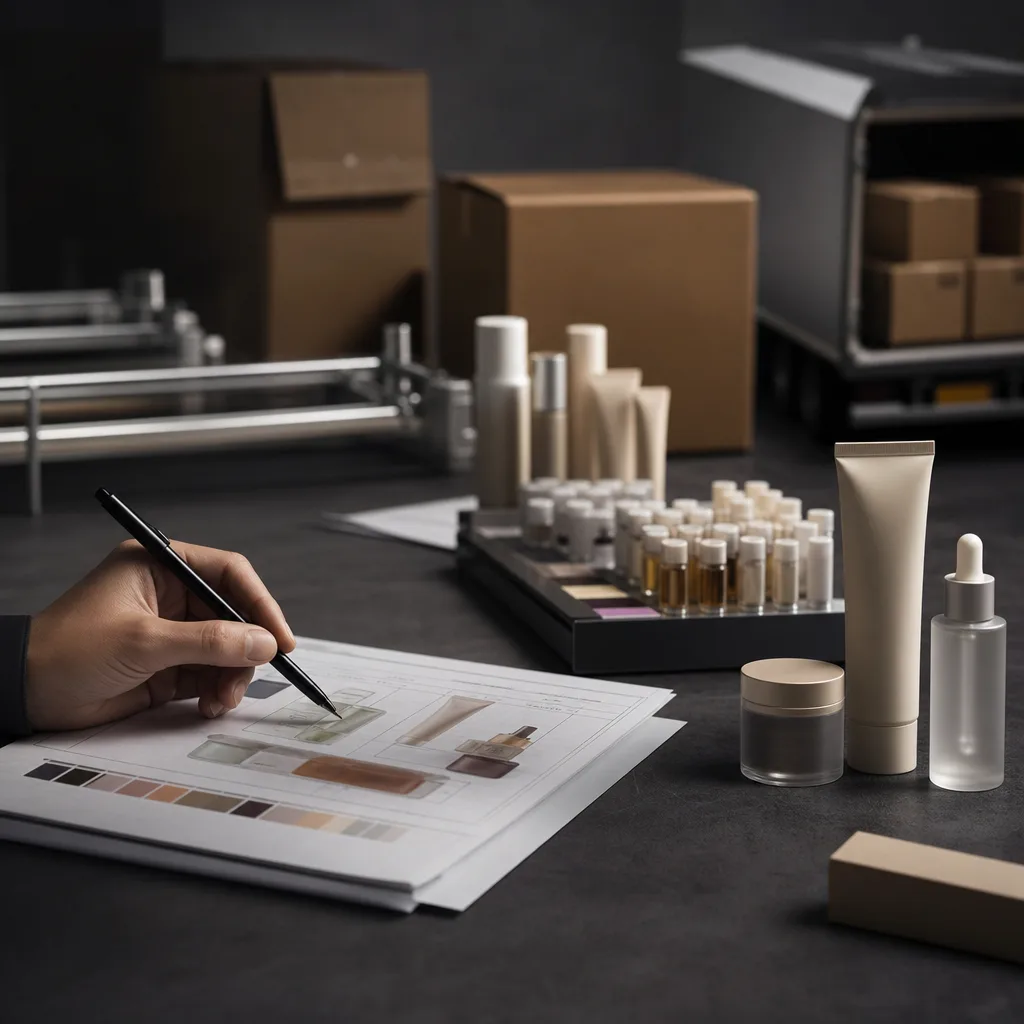
03 · CustomizationHow Far Can Custom Formulation and Turnkey Services Go?
“Custom” in private label refers to a three-tiered spectrum and its length depends upon budgetary constraints; lead time; ability to differentiate; and export regulatory compliance obligations.
1. Option 1 — Applying Your Brand Label to an Existing Proven Stock-Based Formula
You attach your brand label and artwork to an existing formula that has proven stable/manufacturable. The lead time is shorter and the entry barrier is smaller. This option fits best for new brands that intend to quickly verify market response at relatively low quantities/spend on stock items.
2. Option 2 — Semi-Custom
When you choose to make your own private-label cosmetics, what should you expect when working with a contract manufacturer? First, know that there will be some choices you'll need to make about the degree to which you want to customize your product. There are several levels of customization available. Here are the different options:
(1) Option 1: Formula Enhancement
You keep the same base formula as the original product. You're adjusting only color, scent, texture, and possibly other functional ingredients. This is the lowest-cost and lowest-risk method of creating a customized product. It allows you to differentiate your product from others using the exact same formula without having to spend a lot of money on developing a new product.
(2) Option 2: Reformulation
You take the existing formula and modify it as needed to create your customized version of the product. This would include making changes to the concentration of active ingredients, changing the pH level, etc. You may also want to consider adding other functional ingredients.
Using reformulated versions of products means that you've taken the initial formula and modified it to meet your company's needs. You get to control how much of each ingredient is used and in what form it's delivered. The benefit here is you can differentiate your product based on functionality.
However, this process takes longer and costs more than simply enhancing an existing formula. In addition, you run the risk of destabilizing the formula since you've changed many variables.
Stability refers to the ability of a product to maintain its characteristics throughout its shelf life. Reformulating a product increases the likelihood of instability issues due to the number of variables that could affect its performance.
To mitigate this risk, you might find it helpful to work with a contract manufacturer who has experience in reformulating products.
3. Option 3: Full-Custom R&D Turnkey
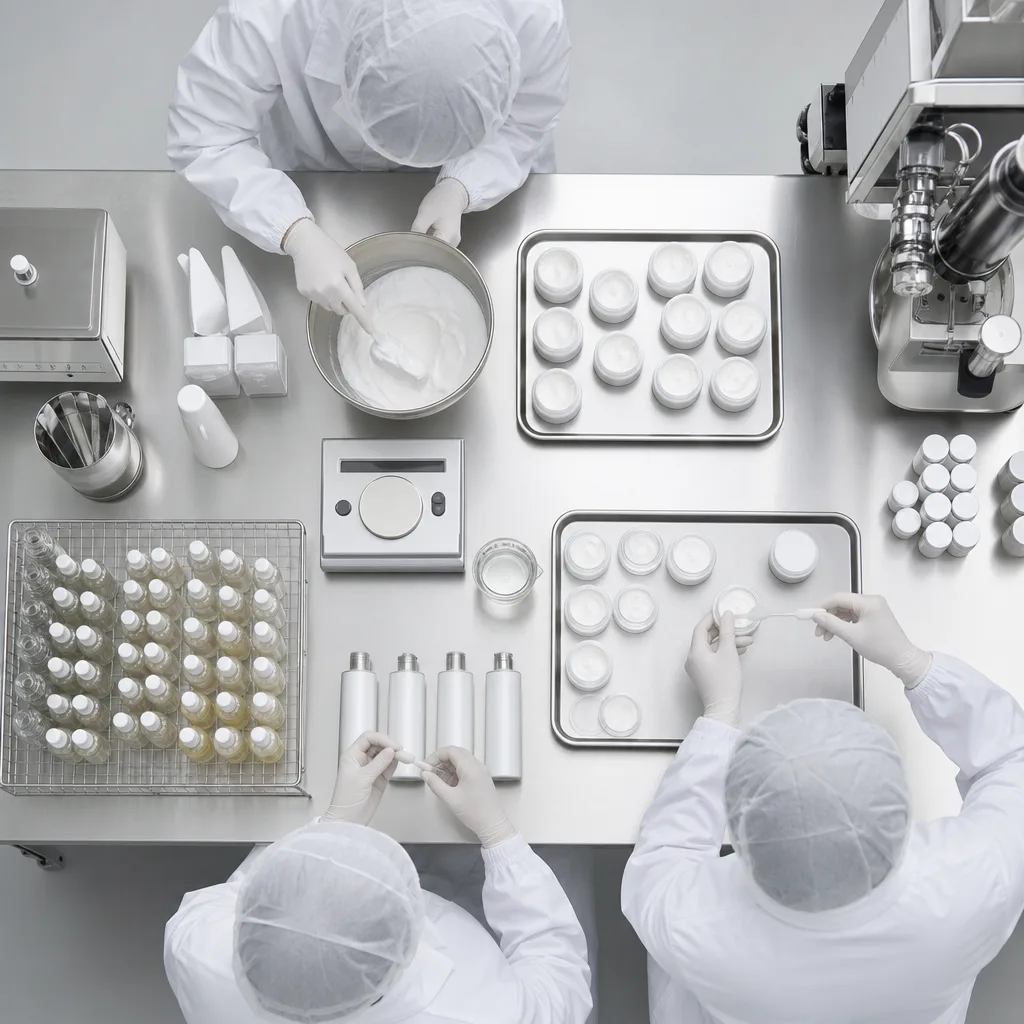
Your contract manufacturer develops a completely new product from scratch just for you. They handle everything including concept development, formula creation, testing for stability, compatibility with containers, and then manufacture and package the final product. The advantage here is that you get a truly unique product that no competitor can replicate easily.
However, this approach is the most expensive and time-consuming. As mentioned earlier, full-custom development involves multiple stages (concept development, formula development, testing) that require significant investment in terms of both time and money.
Also, because your contract manufacturer has invested so heavily in developing a product specifically for you, they may limit how much volume they will allow you to produce initially.
Therefore, this is usually the least preferred option among manufacturers unless you are planning to launch a large-scale marketing campaign immediately after introduction of your product.
Although an OEM agency doesn't typically put all projects under one roof in an all-inclusive turn-key arrangement where they provide everything from concept development to packaging and shipping; an OEM agency does provide the customer with some options to reduce overall costs and risks associated with development.
Options available to help reduce cost include:
Split Component Sourcing
An OEM agency can help break down a fully developed product into smaller component parts. These component parts can be sourced individually.
The advantages of this approach are:
- Lower unit prices compared to buying an entire product;
- Greater flexibility in sourcing individual component parts from various suppliers;
- Reduced inventory holding costs;
The disadvantages of this approach are:
- Requires more coordination and communication between the OEM agency and the end-user;
- Can increase complexity associated with managing different vendors for each component part;
- May lead to inconsistent branding across individual components (e.g., pump vs. bottle);
Another area where an OEM agency can assist customers in reducing costs and risks includes:
Container Options
Packaging containers such as bottles and jars can vary greatly depending on the type of formula being produced. Some formulas may call for specialized containers due to factors like fragrances or high levels of water content.
With container options comes variations in packaging materials and designs. Materials range from glass to plastic and even biodegradable options. Designs include flip-top caps, pumps, spray heads, screw-on caps, and many more.
Each container option varies in price depending on quantity ordered and material type.
A key factor in selecting packaging materials is ensuring compliance with local laws and regulations regarding refillable containers or reusable packaging materials.
An OEM agency can provide guidance on compliant packaging options depending on target markets and help streamline purchasing decisions to minimize costs and maximize efficiency.
04 · SummarySummary
The most cost-effective way to enter into the cosmetics business (and certainly the easiest) is with private label formulations based on a tried-and-true formula. A minimum of 500 – 1000 units of product will be required as the first purchase for testing the marketplace. However, it is that next tier of orders of 3000 – 5000 units that will provide you with the best price point for quality and also give you the greatest amount of flexibility in terms of how long you have to produce additional inventory once you start selling your products. Depending upon how quickly you can approve artwork, confirm payment, etc., the actual time needed to fill and ship product is approximately 3 weeks after receiving a sample sign off. After that point all of these tasks occur simultaneously — container production time and obtaining necessary documentation (i.e. customs forms) for shipment to countries such as United Arab Emirates, Saudi Arabia, and GCC-based destinations pose the largest risk to being able to meet your delivery schedule. Regardless of whether you just want to add a label to a pre-existing formulation or create some level of customization through a semi-private custom labeling or reformulation process or if you want us to completely develop your product from scratch through Research & Development, the most effective strategy for ensuring success is to plan backwards from when you want to deliver your product by determining what quantity you wish to manufacture, the type of packaging you will use and also any necessary paperwork and certifications. If you are prepared to finalize all of these details as well as confirm the exact number of items you want produced and their expected shipping date, do not hesitate — reach out to our team today at https://kbeautyproduction.com/contact/ and we will begin reserving production slots immediately.